
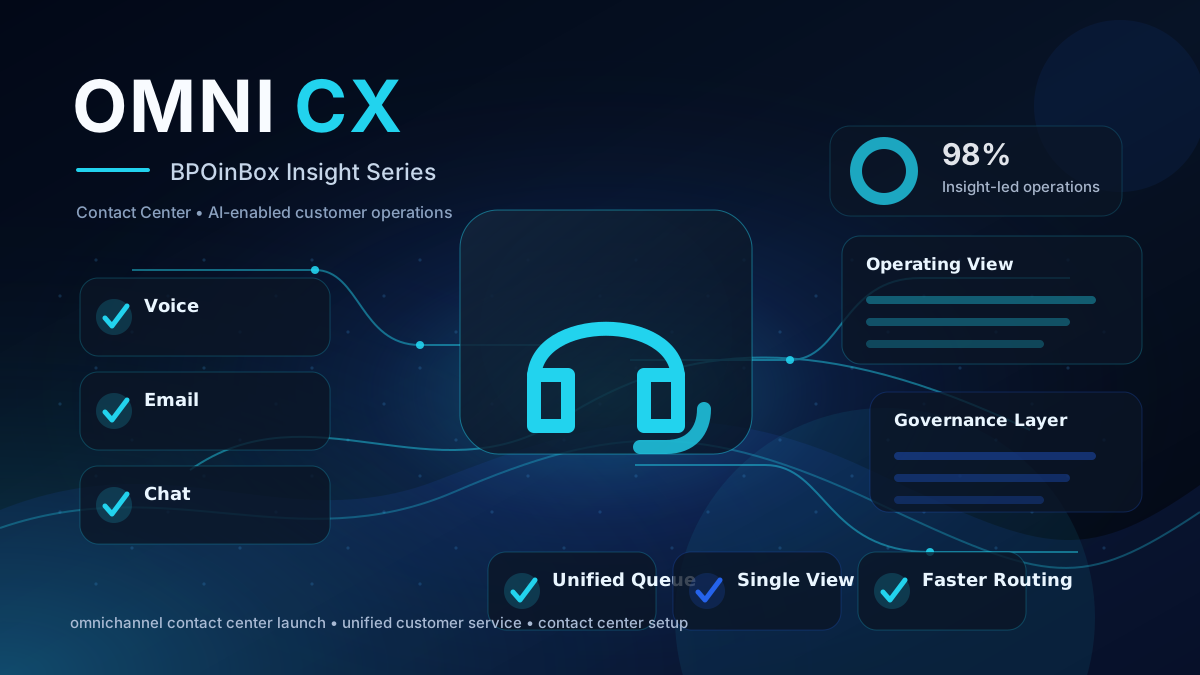
How enterprises can move from disconnected phone, email, chat and WhatsApp teams to one managed service experience.
- Start with a bounded process and clear baseline metrics before scaling.
- Use AI to improve speed, consistency and guidance without removing human judgment from sensitive decisions.
- Connect the topic to SLA, QA, knowledge, analytics and governance routines.
Customers do not think in channels. They move from call to email to WhatsApp depending on urgency, convenience and context, while many organizations still manage these channels separately.
For CX leaders, the risk is not merely operational inefficiency. The risk is that every channel creates a different truth about the customer.
The core issue
Enterprises are under pressure to improve customer experience while controlling cost, reducing operational leakage and maintaining service discipline across channels. This is where a packaged BPO operating model becomes valuable.
Customers do not think in channels. They move from call to email to WhatsApp depending on urgency, convenience and context, while many organizations still manage these channels separately.
What good looks like
A strong omnichannel model starts with common case categories, common priority rules, common escalation paths and a single interaction history for supervisors and agents.
A mature program defines ownership, escalation, quality checks, knowledge controls and management reporting before volume starts moving. It avoids the trap of launching tools first and process discipline later.
Relevant use cases
- Inbound support
- Warranty service
- Retail order support
- BFSI service desks
- Membership and community support
Technology and operating design
The platform should unify voice, email, chat, messaging and web forms into a common workbench with routing, tagging, dispositioning, templates and audit trails.
| People | Role clarity, training, supervised escalation and continuous coaching. |
| Process | SOPs, categorization, handoffs, SLA rules, quality controls and audit trails. |
| Platform | Omnichannel queues, CRM, automation, analytics, knowledge and workflow orchestration. |
| Governance | Daily dashboards, weekly reviews, risk logs, change control and executive visibility. |
Governance and KPIs
Governance should define channel-wise SLAs, ownership across queues, duplicate handling rules, customer consent requirements and daily queue health reviews.
Governance is where many customer-operation programs either mature or drift. A weekly review should not only ask whether the SLA was met; it should ask what is changing, what is recurring and what needs redesign.
Metrics to track
- Channel SLA compliance
- Backlog ageing
- Repeat contact rate
- Queue abandonment
- Digital containment
- Customer effort score
Pitfalls to avoid
- Calling multichannel tools omnichannel
- Ignoring customer identity stitching
- Letting each channel define its own priorities
- Reporting channel volumes without journey context
How BPOinBox helps
BPOinBox can become the operating wrapper around omnichannel tools by combining channel orchestration, agent workflows, supervisor visibility and AI-enabled triage.
The value of a packaged model is that it compresses the journey from idea to execution. Instead of separately designing people, process, tools, reporting and governance, the enterprise can start with a ready operating blueprint and adapt it to the process context.
This article is part of the BPOinBox Insight Series for CX, BPO, digital transformation and customer operations leaders evaluating practical AI-enabled operating models.
Planning a customer operations transformation?
BPOinBox can be positioned as a modular operating layer for enterprises that need AI-enabled scale, omnichannel coverage and management visibility.
Request a walkthroughFAQs
Why is omnichannel contact center launch important for modern customer operations?
It matters because customer operations now need faster response, better consistency, clearer governance and measurable outcomes across channels. The leadership question is whether the operating model can be launched, governed and improved like a digital product.
Where should an enterprise begin?
Start by mapping current demand, top intents, workflow gaps, data risks and the KPIs that leadership already reviews. Then pilot a contained use case before scaling.
How does BPOinBox fit into this journey?
BPOinBox can become the operating wrapper around omnichannel tools by combining channel orchestration, agent workflows, supervisor visibility and AI-enabled triage.